Representation in blockbuster films often goes deeper than what’s on screen. It begins with the voices behind the scenes. In the case of Sinners, the latest hit from Warner Bros Pictures, one of the most talked about scenes in the film Grace Chow (portrayed by Li Jun Li) has become one of the most hotly debated characters in the film.
If you haven’t seen the movie Sinners, please do not read further as spoilers will be mentioned below.
Sinners has sparked intense discussions across social media about loyalty, identity, and cultural intersectionality. In the film’s pivotal moment, Grace’s controversial decision to invite vampires inside of Smoke and Stack’s (Michael B. Jordan) Club Juke has ignited passionate discourse online. Many viewers see her actions as a layered commentary on survivalism, assimilation, and the historical complexities of cross-cultural alliances under pressure. Others have criticized the move as a symbolic act of betrayal, questioning whether the film reinforces harmful stereotypes or opens a necessary dialogue about trust and belonging in Black spaces.
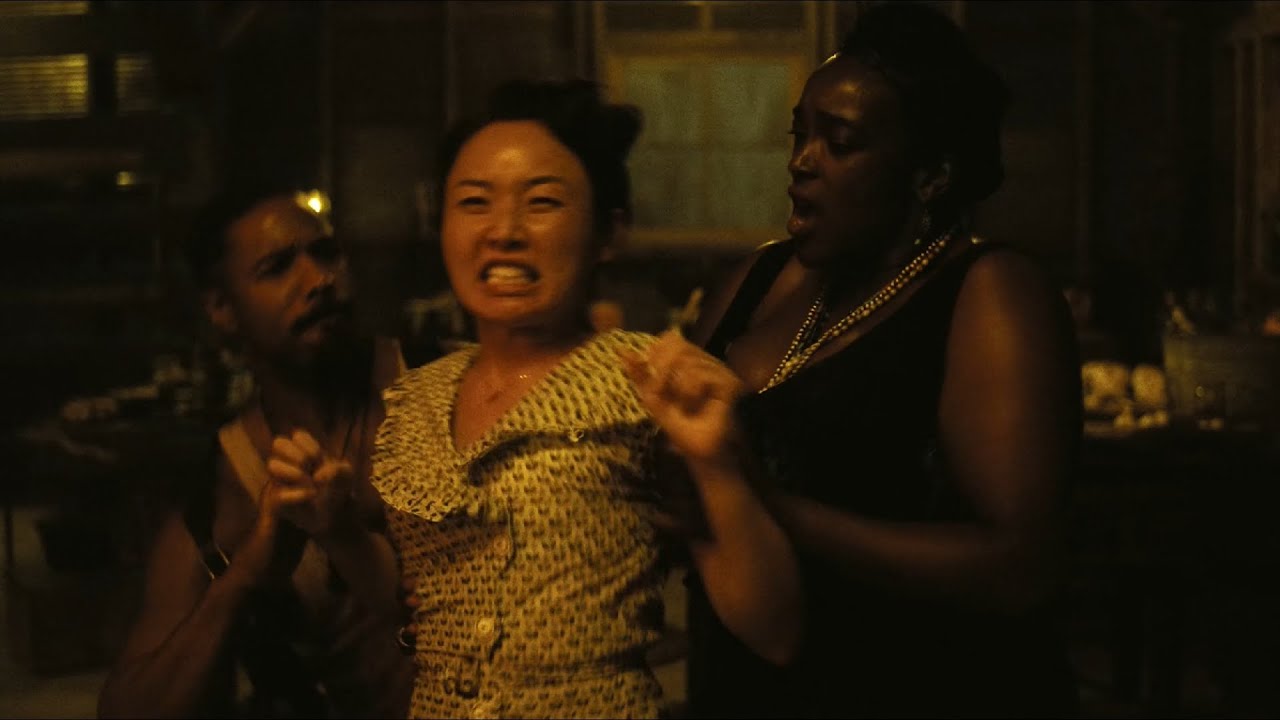
Across TikTok videos, X (Twitter) debates, and Reddit think pieces, Grace has emerged as a lightning rod for conversations about how marginalized characters navigate systems of power and whether her choice was an act of desperation, complicity, or quiet rebellion.
Chinese culture and history play a crucial role in shaping the film’s emotional core and authenticity. That authenticity is no accident and it’s rooted in the contributions of cultural consultant and journalist Dolly Li, whose work bridges storytelling and identity. As it relates specifically to this controversial scene, it was brought up in this week’s IN PROXIMITY podcast. Li sat down with host Paola Mardo and discussed how the moment is far more layered than it appears.

Li explains that when Remmick (Jack O’Connell) speaks to Grace in her native language — something he does with no other character — it triggers a powerful emotional response rooted in the immigrant experience. “As an immigrant, when someone speaks to you in your mother tongue, it evokes something beyond logic,” Li says. “It can awaken memories, vulnerabilities, and even a survival instinct.”
She also adds a fascinating layer of historical and linguistic accuracy. “I responded with that era, the most immigrants came from either Canton or Toisan. The early, early immigrants really did come from Toisan, and a lot of them could speak Cantonese. But I was like, if you want to be super accurate, Toisan, but how many people will understand it? Not that many. You could go with Cantonese and easily get away with it, but I love that they went all the way and chose Toisan. Toisan and Cantonese were the two communities that made up the early immigrants. Toisan is in southern China, within the Canton region, but they speak their own dialect.”
This film just further demonstrates how careful attention to dialect, history, and language can transform a scene from mere plot point to cinematic artistry.


Li interprets Grace’s decision as one born from deep emotional manipulation and not a simple act of treachery. Remmick weaponizes language and love, embodying the soul of Grace’s late husband to exploit her trust. The result is a moment that’s both heartbreaking and haunting. One that reveals the film’s brilliance in weaving heritage, identity, and power into its storytelling.
Li adds:
Because when you’re an immigrant in America and you don’t speak English and someone speaks to you in your native language, it evokes this emotion in you that is so hard to describe, right? It’s not just like code-switching. You’re unlocking a totally different side of the brain. And I think this is why I think the film was also so brilliant in that moment where you have this Irish vampire who was able to embody the soul of her husband, to the degree where he could tap into this really deep language to really mess with her and her emotions like that is that is some really dark, dark, spiritual stuff”
In the end, Grace’s choice serves as a mirror for audiences, reflecting the difficult moral terrain that immigrants and outsiders often navigate in pursuit of safety and belonging. By centering such a complex, emotionally charged moment, Sinners pushes viewers to reconsider how betrayal, survival, and identity intersect. And how language can be both a bridge to connection and a weapon of control.